How it works
Vertical strips = (C−1) × R; horizontal strips = (R−1) × C; cornerstones = (R−1) × (C−1).
Create a grid of independent quilt blocks joined by short sashing strips and cornerstones. Check your strip quantities before cutting.
4 rows × 5 columns gives 16 vertical strips, 15 horizontal strips and 12 cornerstones. At 10 in blocks and 2 in sash: 58 × 46 in.
Understand the calculation before cutting into fabric.
Vertical strips = (C−1) × R; horizontal strips = (R−1) × C; cornerstones = (R−1) × (C−1).
Enter finished block width/height, grid rows/columns and finished sash width. This plan assumes independent strips between adjacent blocks and a cornerstone at every intersection.
There is no outside edge sashing in this construction. Other joining methods need a separate geometric model.
4 rows × 5 columns gives 16 vertical strips, 15 horizontal strips and 12 cornerstones. At 10 in blocks and 2 in sash: 58 × 46 in.
Sashing adds finished width between blocks, while cut dimensions still need seam allowance. This tool models short independent strips between adjacent blocks, with cornerstones at grid intersections.
For a 4 × 5 arrangement of finished 10-inch blocks with 2-inch finished sashing, there are (5 − 1) × 4 = 16 vertical strips, (4 − 1) × 5 = 15 horizontal strips and (4 − 1) × (5 − 1) = 12 cornerstones.
The finished grid measures 5 × 10 + 4 × 2 = 58 inches wide and 4 × 10 + 3 × 2 = 46 inches high. At ¼-inch seam allowance, the sashing cut width is 2½ inches; a strip next to a 10-inch block is 10½ inches long.
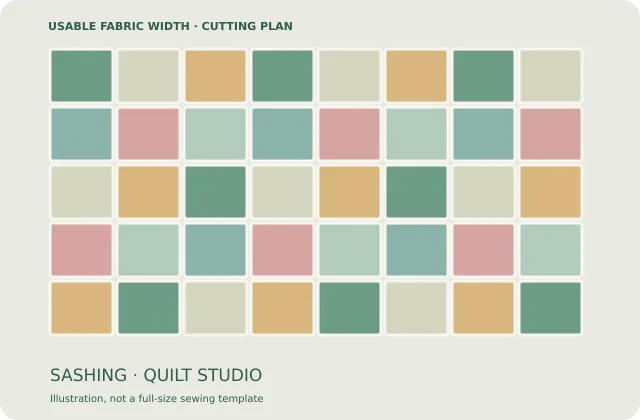
The calculator lays out the separate strips and cornerstones as actual rectangles on the usable fabric width. It does not add outer sashing around the entire grid, and it does not model long continuous rows of sashing without individual cornerstones.
Count the intended blocks and joints before purchasing. If you need outer borders, send the finished grid width and height to the Border Calculator instead of counting them here twice.
For R rows and C columns, (R−1) × (C−1).
No, it includes only sashing between neighboring blocks.
Yes, all cut rectangles include seam allowances.