How it works
Arrange cut rectangles in deterministic, nonoverlapping rows for each SKU; sum required run length within that SKU; adjust for prewash and round the final purchase quantity once.
Assign each fabric a separate SKU and list your actual piece cut sizes. The layout and yardage stay separated to prevent mixing two colors in one cut plan.
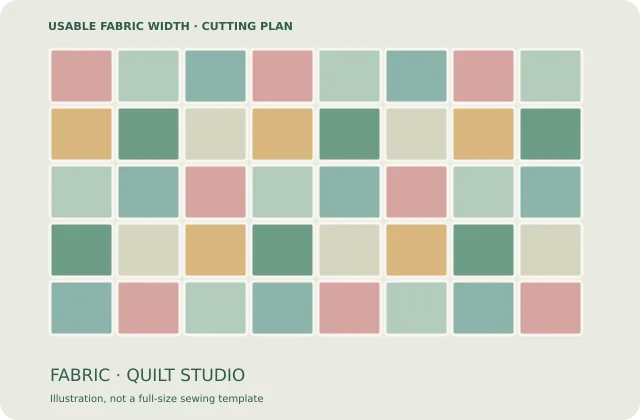
A sample project uses separate blue 5 × 5 in squares and sand 4½ × 8½ in rectangles, each with a distinct SKU and fabric run.
Understand the calculation before cutting into fabric.
Arrange cut rectangles in deterministic, nonoverlapping rows for each SKU; sum required run length within that SKU; adjust for prewash and round the final purchase quantity once.
Add fabric groups and rectangle batches with quantities. Set cut sizes that already include seam allowance, and give each group its own usable WOF.
No separate SKUs are combined. Feasible shelf packing is not claimed to globally minimize scraps.
A sample project uses separate blue 5 × 5 in squares and sand 4½ × 8½ in rectangles, each with a distinct SKU and fabric run.
Piece dimensions, quantities, grain permissions and usable WOF belong to a specific fabric SKU. Keep those materials independent even when the pattern needs many colors.
The sample blue fabric contains twelve 5 × 5 inch cut squares. On 43 inches of usable width, eight squares fit across a row, so two rows take 10 inches along that bolt. The sand fabric has eight 4½ × 8½ inch rectangles; nine could fit across 43 inches, so a single 8½-inch row covers all eight.
Those runs are independent: 10 inches for blue and 8½ inches for sand. They must be rounded to shop purchasing increments separately and cannot be combined into a fictional 18½-inch roll because the colors are different.
Disable 90° rotation for directional prints, visible fabric grain or motifs that cannot be turned. Only explicitly allowed orientations are considered. Prewash length shrinkage increases the required purchased length before shop-increment rounding.
Use the cut sizes after accounting for seam allowance. If a rectangular piece cannot fit your chosen width in any permitted direction, that SKU displays an impossible-fit warning instead of an unsupported yardage suggestion.
The shopping CSV separates rounded buying quantities, the cutting-run length and roll offcuts by SKU. The cut-list CSV shows each physical rectangle with its position on its own fabric roll. User-entered prices are estimates only, not a live retailer quote.
Yes, each color receives an independent SKU and cutting plan.
No, these are literal cut dimensions; add seam allowance first.
No, unit prices are entered by you; nothing is fetched or sold.