How it works
Across = floor(WOF ÷ cut width); rows = ceil(number of pieces ÷ across); run length = rows × cut height. Compare the 90° orientation only if allowed.
Enter rectangle cut dimensions, number of pieces and usable WOF. The tool fits the pieces into physical rows rather than dividing fabric area.
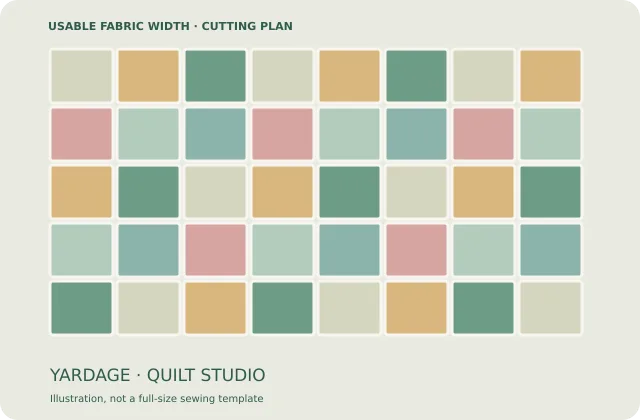
20 pieces × 5 × 10 in on 43 in WOF → 30 in run = ⅞ yd. Rotating to 10 × 5 gives 25 in run = ¾ yd.
Understand the calculation before cutting into fabric.
Across = floor(WOF ÷ cut width); rows = ceil(number of pieces ÷ across); run length = rows × cut height. Compare the 90° orientation only if allowed.
Input the actual cut dimensions including seam allowance. Enable rotation only for fabric designs and grain that permit turning rectangles.
If pieces cannot fit across the roll in any allowed orientation, the calculator reports FIT_IMPOSSIBLE instead of an area-based estimate.
20 pieces × 5 × 10 in on 43 in WOF → 30 in run = ⅞ yd. Rotating to 10 × 5 gives 25 in run = ¾ yd.
The fabric width is a hard geometric limit. To buy enough cloth, the calculator places the requested pieces into rows on a usable fabric roll and measures the resulting cutting run.
On 43-inch usable WOF, eight 5-inch-wide rectangles fit across a row. Twenty pieces therefore need three rows, each 10 inches long: 30 inches of total run, or 0.8333 yards raw, rounded to ⅞ yard with eighth-yard purchasing.
If the print and grain permit a 90° turn, four 10-inch-wide pieces fit across each row, requiring five rows of 5 inches each. That is 25 inches of run, rounded to ¾ yard. Rotating is optional, never an assumption for one-way prints.
Enter the real sizes of the rectangles you intend to cut. If a finished patch is 4 × 4 inches and your construction uses ¼-inch seams on every side, the cut patch is typically 4½ × 4½ inches. A finished block size cannot be fed in unchanged as the cutting dimension.
Total square inches alone do not prove a cut is feasible. Two rectangles with the same area can have very different widths and grain restrictions. The visual plan and CSV show the exact proposed placements.
No. Enter the actual width available for cutting.
It means pieces may rotate 90 degrees without violating pattern or grain restrictions.
No. This approach finds a feasible uniform row plan, not the global optimum.