How it works
Your shared quilt measurements feed separate backing, batting, straight-grain binding, border and fabric algorithms. Every material has its own verified layout.
Enter finished quilt dimensions once. Build a cut-ready materials plan from your real fabric widths, seam allowances, grain and purchasing increments.
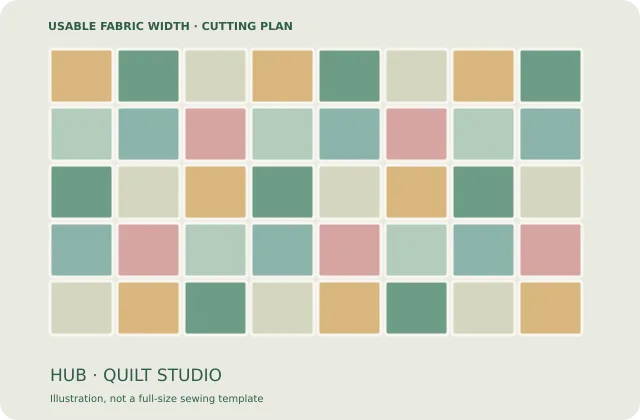
Sample: 60 × 80 in quilt, 4 in backing overage and 43 in WOF. Vertical backing needs 5 yd; straight binding needs ⅝ yd.
Understand the calculation before cutting into fabric.
Your shared quilt measurements feed separate backing, batting, straight-grain binding, border and fabric algorithms. Every material has its own verified layout.
Start with the 60 × 80 in sample. Adjust your widths, overage and other measurements. Visit the individual tools for advanced settings, then return to review the materials summary.
Only feasible cut layouts produce purchase quantities. Different materials remain separate, even if the fabrics have the same color. Not every sewing method is covered.
Sample: 60 × 80 in quilt, 4 in backing overage and 43 in WOF. Vertical backing needs 5 yd; straight binding needs ⅝ yd.
A quilt top, backing, batting, binding and each colored fabric are different purchases. The planner shares project dimensions, then calculates each material using its own usable width, cutting requirements and verified roll layout.
Record the finished quilt-top width and height. Measure usable width of fabric (WOF) after excluding selvedges, and decide how much backing and batting overage is required for your quilting method. Enter cut dimensions—including the appropriate seam allowances—for individual top pieces.
Enter separate fabrics as separate SKUs, even when colors look similar. A quantity from one fabric roll must not silently be added to a different SKU or to a batting roll.
Exact cutting-run length is not the same as rounded purchase yardage. The planner computes a physical cutting run, adjusts length for the specified prewash shrinkage where applicable, and rounds the purchase upward once to the selected shop increment.
Download the itemized shopping CSV or individual cut-list CSV to check each material. The PDF is a schematic showing measurements and coordinates—not a full-size sewing template. When the selected material cannot physically fit, no purchasing estimate should be treated as proven.
Backing joins consume fabric along seams; straight-grain binding consumes length at strip joints; batting is limited to a single piece; butted borders use side strips before top and bottom strips. The specialized calculators expose their own assumptions and dimensions.
The planner does not calculate diagonal backing, bias binding, mitered borders or a globally optimal mixed-shape nesting solution. These are different construction problems and require separate validated methods.
Yes. Calculation runs on your device without an account or API.
You can export or import a versioned local JSON file.
No. The cutting diagrams prove feasibility rather than mathematical minimum waste.